
Winbuzz Slots as a Structured Game Library
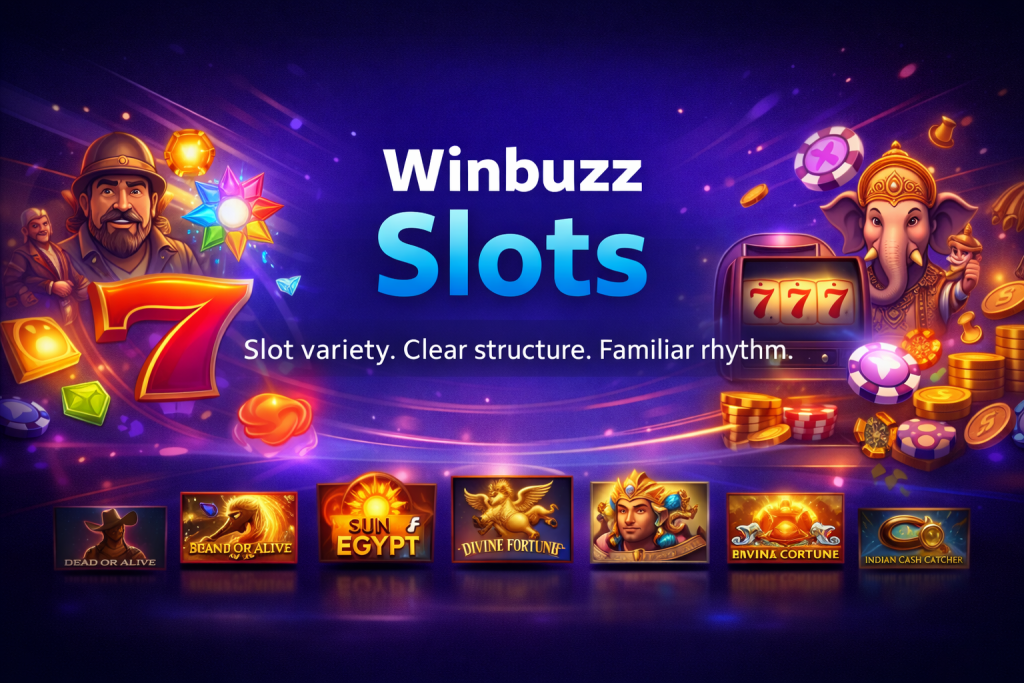
The slots section on Winbuzz should not be read as a flat list of titles placed next to each other without internal logic. A mature casino platform benefits from presenting its slot library as a structured environment where different player needs, session styles, and mechanic preferences can coexist without confusion. That matters especially in an India-facing context, where the audience is often broader in taste and less interested in being pushed toward a single “hero” title. Some users want short, recognisable sessions built around simple visual rhythm. Others want heavier feature density, stronger volatility contrast, or titles that feel more thematic and cinematic. A good slots page should help both groups read the catalogue clearly.
What makes this library useful is not only the presence of known international titles such as Starburst, Gonzo’s Quest, Dead or Alive, Divine Fortune, or Book of Dead, but also the coexistence of games that connect more directly with local thematic familiarity, such as Pearls of India, Bollywood Story, Indian Cash Catcher, Ganesha Fortune, and Hanumanji. This creates a portfolio with two different but compatible layers. The first is recognisability through globally established slot design. The second is contextual familiarity through titles that feel closer to regional imagery, tone, or table-culture crossover. Together, these layers make the slot section feel broader and more intentional.
That portfolio becomes even more interesting when hybrid or adjacent game categories are present inside the same browsing environment. Titles such as Teen Patti, Andar Bahar, and patti rummy are not slots in the strict mechanical sense, yet their presence on the same page changes how the user reads the wider game mix. Instead of treating the page as a narrow reel-only catalogue, the platform can present it as a broader chance-and-rhythm environment where slot sessions sit next to culturally familiar card-led formats. This does not mean the categories should be blurred. On the contrary, the strongest editorial approach is to keep the boundaries clear: slots remain reel-driven RNG products, while Teen Patti, Andar Bahar, and rummy-adjacent formats should be framed as separate interaction models with different pacing and expectations.
From a product perspective, the most important thing is to avoid presenting the slot section as a race for excitement. A stronger operator-level approach is to explain that the value of a slot library lies in variation of tempo, feature density, symbol logic, and session feel. Starburst is not useful because it is “big” or “hot,” but because it represents a cleaner and more readable style of reel interaction. Dead or Alive matters because it sits at a very different end of the volatility spectrum and therefore serves a different session intention. Gonzo’s Quest and Sun of Egypt 3 bring stronger feature identity. Fruit Bonanza and 777 Fire Strike connect more easily with players looking for direct, legible visual structures. Once the page is written this way, the library starts to feel curated rather than stacked.
Reading the Slot Mix by Session Style
One of the biggest weaknesses on many casino slot pages is that games are grouped only by keyword value or brand familiarity. That creates clutter. A more useful approach is to help the reader understand how different slots behave at the session level without pretending that any of them provide predictable returns in the short run. This is where editorial clarity matters. A game can be described as calmer, denser, more feature-led, more visually direct, or more variance-heavy without making promises about what the next session will deliver. That is the correct language because it describes structure, not outcomes.
In practical terms, Winbuzz has enough variation in this list to support several distinct session profiles. There are titles suited to lighter browsing and lower cognitive load, including Starburst and Fruit Bonanza, where the readability of symbols and the immediate visual rhythm make entry easier. There are titles built around stronger thematic framing and more deliberate feature anticipation, such as Gonzo’s Quest, Sun of Egypt 3, and Divine Fortune, where the session often feels more shaped by internal mechanics than by constant baseline simplicity. Then there are games that naturally attract players who are already comfortable with sharper variance or older-school slot tension, such as Dead or Alive and Book of Dead, both of which tend to be understood less as casual browsing tools and more as intentional session choices.
The India-facing side of the catalogue should be handled with equal discipline. Titles like Pearls of India, Bollywood Story, Indian Cash Catcher, Ganesha Fortune, and Hanumanji can create immediate thematic accessibility, but they should not be treated as cultural shortcuts or decorative filler. The right approach is to describe them as part of the platform’s broader content balance: they widen symbolic familiarity, make the library feel less generic, and give the page local texture without replacing the need for strong mechanical explanation. Thematic familiarity can improve discoverability, but it should never stand in place of clarity about volatility, feature design, and session tempo.
That same discipline applies even more strongly to titles like Teen Patti, Andar Bahar, and patti rummy. Because these names are highly familiar in the Indian gaming space, there is a temptation to absorb them into a slots page without explanation. A better editorial decision is to acknowledge their presence while making the category boundary explicit. They contribute to the wider content ecosystem around the slots section, but they should not be misdescribed as reel-based slot products. This protects the page from category confusion and also makes the platform look more credible. Precision is part of trust.
Slot Portfolio Snapshot
Category Precision Matters on a Page Like This
Because the Winbuzz list includes both classic slot titles and culturally familiar non-slot names, the page has to maintain a careful editorial balance. It should be broad enough to reflect the actual game environment, but precise enough to prevent category dilution. That is why the strongest way to position this page is not to force every listed title into the same box, but to explain how the slot library sits inside a larger gaming framework. The slot catalogue remains the centre of the page, yet surrounding familiarity from Teen Patti, Andar Bahar, and patti rummy helps shape how an India-based audience reads the platform as a whole.
This kind of precision improves more than clarity. It improves brand perception. A casino that can describe its own content ecosystem accurately looks more controlled, more credible, and less promotional. That matters because the slots page is not only a conversion surface. It is also a statement about how the platform thinks. If the page can distinguish between visual familiarity, session structure, thematic accessibility, and true game mechanics, it begins to feel closer to a product surface and further away from generic gambling copy.
Volatility, Tempo and Feature Density as Reading Tools (Not Promises)
A slot catalogue only becomes useful when the user understands how to read it beyond titles and themes. The three most stable lenses for that are volatility, tempo, and feature density. None of these describe outcomes in a predictive sense, and none of them should be framed as indicators of profitability. What they do instead is describe how a session tends to feel over time — how often events occur, how concentrated value distribution is, and how much of the experience is driven by base spins versus internal mechanics. This is the level at which an operator-level slots page should speak, because it gives the user a way to navigate the library without creating false expectations.
Volatility is often misinterpreted as a measure of “how much a slot pays.” That framing is inaccurate and leads to poor decision-making. A more precise definition is that volatility describes the distribution of outcomes across time. A lower-volatility slot tends to distribute smaller events more frequently, while a higher-volatility slot concentrates outcomes into less frequent but more pronounced events. Neither of these structures guarantees anything about a short session. A player can experience a long quiet period in a lower-volatility slot or a dense sequence of events in a higher-volatility one. The key point is structural tendency, not short-term behaviour.
Tempo complements volatility by describing how quickly a session progresses from one event to another. Some titles feel continuous and rhythm-based, where each spin transitions quickly into the next with minimal interruption. Others feel more deliberate, with stronger emphasis on anticipation, feature triggers, or pauses in the flow. Tempo does not change the mathematical expectation of a game, but it changes how the session is perceived. This is why two slots with similar RTP can feel entirely different in practice. One may be read as smooth and consistent, while another may feel segmented and event-driven.
Feature density adds a third layer. It reflects how much of the session is defined by internal mechanics such as cascading reels, bonus rounds, expanding symbols, or multi-stage features. A slot with low feature density relies more on base game readability. A slot with high feature density shifts attention toward triggered events and internal progression. Again, this is not a measure of value, but of structure. Understanding this distinction helps the user choose a slot based on experience preference rather than expectation of return.
Structural Profile of Winbuzz Slots
The chart below should be read as a qualitative model. It does not measure profit, growth, or performance. It simply compares how different groups of slots behave in terms of volatility concentration, tempo flow, and feature intensity across the Winbuzz library.
Interpreting These Differences Without Overreading Them
The purpose of this kind of model is not to guide the user toward a “better” slot, but to prevent misinterpretation of what different slots are designed to do. A player who prefers continuous visual flow and lower interruption may naturally gravitate toward titles like Starburst or Fruit Bonanza, not because they are more rewarding, but because they are easier to read and maintain a steady rhythm. A player who enjoys internal mechanics and recognisable feature triggers may prefer Gonzo’s Quest or Sun of Egypt 3, where the session feels more structured around events rather than pure repetition.
Similarly, titles like Divine Fortune and Book of Dead tend to attract users who are comfortable with waiting for feature cycles, while Dead or Alive is often approached by players who already understand what higher volatility implies in structural terms. None of these choices guarantee a particular outcome, and none of them should be presented as strategies. They are simply different ways of experiencing the same underlying system: a memoryless RNG that resolves each spin independently of the previous one.
This is why the slots page should resist the urge to collapse everything into ranking language. Once the user understands how volatility, tempo, and feature density interact, the need for exaggerated descriptors disappears. The library becomes navigable through structure instead of hype, and that is exactly what separates a product-level page from a promotional one.
Local Familiarity, Category Boundaries and How the India-Facing Mix Should Be Read
A slots page for Winbuzz becomes more credible when it reflects the actual shape of the catalogue instead of forcing every title into a single simplified category. This matters because the list here combines globally recognisable slot products with regionally familiar themes and several game names that naturally belong closer to card-led or traditional table-style formats. A weaker page would flatten all of this into a generic “popular slots” structure. A stronger page keeps the portfolio broad, but draws clearer category boundaries so the user understands what kind of interaction model each title represents. That improves both readability and brand trust.
The first layer of the page is the international slot anchor set. Titles such as Starburst, Gonzo’s Quest, Dead or Alive, Divine Fortune, and Book of Dead give the library a recognisable backbone. These games are useful because they represent clear slot-reading patterns: simple base flow, mechanic-led structure, variance-heavy distribution, or feature-first session identity. They give the page a common language that many users already understand. Once those anchors are in place, the second layer — Pearls of India, Bollywood Story, Indian Cash Catcher, Ganesha Fortune, and Hanumanji — can be framed more intelligently. These games add regional texture and symbolic familiarity, but they should still be explained through session structure rather than theme alone. The page stays stronger when local imagery is treated as context, not as a substitute for mechanical clarity.
The third layer is where precision becomes most important. Teen Patti, Andar Bahar, and patti rummy are highly familiar names in the Indian gaming context, but they should not be blended into reel-driven slot logic without explanation. Even if they appear inside the same browsing environment, they belong to a different interaction model. Slot games are reel-based RNG products with spin-by-spin resolution. Teen Patti and Andar Bahar are read through card logic, while rummy-adjacent formats follow their own structure of interaction, expectation, and pacing. A good operator-level page acknowledges that these titles strengthen the local gaming ecosystem around the slots section, but it does not mislabel them. That is exactly the kind of precision that makes a casino page feel deliberate rather than careless.
From a product standpoint, this mixed structure is actually an advantage. It allows Winbuzz to feel less like a one-dimensional slot shelf and more like a broader gaming surface adapted to the reading habits of an India-based audience. Some users arrive with a clear preference for classic video slots. Some recognise familiar local themes and use those as an entry point. Others move more naturally toward card-led titles and then return to reels later. The page should support that movement without collapsing the categories into each other. A strong casino platform does not need to pretend that everything is the same. It only needs to make the differences legible.
Catalogue Mapping by Interaction Type
The table below groups the Winbuzz list by content role and interaction model. This is not a quality ranking. It is a structural map that shows how different titles contribute to the overall library.
| Group | Included Titles | Interaction Model | Editorial Reading |
|---|---|---|---|
|
Group International Slot Anchors Recognisable slot titles that give the page a stable global reference frame. |
Included Titles
Starburst
Gonzo’s Quest
Dead or Alive
Divine Fortune
Book of Dead These titles form the best-known slot layer in the list and help users read the library through familiar reel logic. |
Interaction Model
Reel-based RNG Each session resolves through independent spin logic and feature structures tied to the slot itself. |
Editorial Reading
Core slot reference Useful for explaining volatility, tempo, and feature density without relying on local theme alone. |
|
Group India-Themed Slot Layer Titles that add regional familiarity and symbolic relevance within the slot section. |
Included Titles
Pearls of India
Bollywood Story
Indian Cash Catcher
Ganesha Fortune
Hanumanji These games widen contextual familiarity, making the library feel less generic for an India-based audience. |
Interaction Model
Reel-based RNG Despite the stronger regional identity, they should still be read as slots first, not as culture-only content pieces. |
Editorial Reading
Theme-led entry Theme improves discoverability, but the page should still explain these titles through mechanic structure and session feel. |
|
Group Mid-Library Session Builders Titles that fill the space between simple entry slots and more feature-dense anchor games. |
Included Titles
777 Fire Strike
Fruit Bonanza
Sun of Egypt 3 This layer helps smooth the library by offering readable but distinct session structures across different player preferences. |
Interaction Model
Mixed tempo slots Some titles lean toward direct readability, while others depend more heavily on feature cycles and internal pacing. |
Editorial Reading
Bridge category Useful for explaining how a library transitions from lighter entry points to stronger mechanic-led sessions. |
|
Group Card-Adjacent Familiar Titles Highly recognisable names in the Indian gaming space that should not be misdescribed as slots. |
Included Titles
Teen Patti
Andar Bahar
patti rummy These titles strengthen local familiarity around the slot section, but they follow a different interaction logic from reel-based products. |
Interaction Model
Card / table logic They should be framed as separate gaming formats even when surfaced close to slots in the wider browsing environment. |
Editorial Reading
Boundary-sensitive A precise page acknowledges their role in the ecosystem without flattening category distinctions. |
Why This Boundary Work Improves the Page
A page like this becomes stronger when it avoids two common mistakes at the same time. The first is treating every game as if it belongs to the same slot model. The second is treating local familiarity as enough on its own. Both approaches weaken editorial value. If all titles are flattened into a single list, the user loses structural understanding. If local names are relied on too heavily without mechanic explanation, the page becomes shallow and decorative. The better approach is to combine local relevance with clear category logic.
This is especially useful in a market-facing environment where users often navigate through recognition first. Some may click on Starburst because it is globally familiar. Others may notice Ganesha Fortune or Bollywood Story because the names feel closer to their own symbolic context. Others may come in through Teen Patti or Andar Bahar and then explore slots later. None of these routes is wrong. What matters is that the page helps the user understand where they are inside the catalogue and what kind of session logic each title represents. That is what turns browsing into orientation instead of noise.
A strong slots page therefore acts as both a content surface and a sorting mechanism. It does not only present games. It teaches the reader how to interpret them. That is where operator-level writing becomes more valuable than promotional writing. Hype compresses differences. Good editorial structure clarifies them.
RTP, RNG, Demo Mode and How a Slot Session Should Actually Be Interpreted
A slots page reaches its most useful point when it explains not only what titles exist in the library, but also how the user should think about results, testing, and short-term session behaviour. This is where four ideas matter more than anything else: RTP, RNG, volatility, and demo use. These concepts are often mentioned across casino pages, but they are frequently blended together in ways that confuse players. A stronger Winbuzz slots page should separate them clearly, because each one belongs to a different layer of understanding. RTP describes a long-term statistical model. RNG describes the independence of each spin. Volatility describes the distribution pattern of outcomes. Demo mode is simply a tool for exploring mechanics. Once these definitions are separated properly, the library becomes much easier to read without exaggerated claims or false confidence.
RTP should never be framed as a short-session promise. It is a long-run theoretical return model attached to a game across a very large volume of play. That means it is useful as a structural reference, but it does not tell the player what will happen in the next ten, twenty, or one hundred spins. A title with a strong long-term RTP profile can still feel quiet in a short session, while another title may produce more visible activity without that saying anything meaningful about its long-run model. This is why a serious slots page avoids phrases that imply session predictability. RTP is relevant, but only when understood at the scale it was designed for.
RNG is even more important because it defines the independence of every spin. A slot does not remember that the user has just won, just lost, just signed up, activated a bonus, switched devices, or returned after a break. The spin resolves independently of previous outcomes and independently of the account state surrounding it. This matters because it protects the boundary between platform logic and game mathematics. The platform may create accounts, apply verification, manage wallets, or attach bonus conditions, but none of these layers influence the randomness of the next spin. That separation is what keeps the product credible. Operational rules belong to the account. Outcome generation belongs to the game engine.
Volatility sits between those two ideas as a description of distribution, not of fairness and not of expected gain. A lower-volatility slot tends to spread smaller events more frequently, while a higher-volatility slot tends to concentrate more of its value into less frequent, more uneven intervals. That does not make one model better than the other. It simply means different slots create different session textures. Some players prefer cleaner rhythm and more regular visual reinforcement. Others prefer feature-heavy structures with longer quiet phases and stronger event concentration. The key is not to confuse that preference with predictive value. Volatility changes feel, not certainty.
Demo mode should be read with the same precision. Its purpose is to let the user explore symbol structure, reel flow, feature triggers, interface rhythm, and basic game understanding without staking real balance. That makes it useful for orientation, especially in a large library where titles differ substantially in pacing and mechanic design. But demo mode is not a forecasting tool. It does not show how a future real-money session will “go,” and it should never be presented that way. The strongest editorial framing is simple: demo helps the user understand how a slot is built, not what it will deliver.
Session Logic Across the Winbuzz Slot Mix
The final chart below should be read as a qualitative dashboard. It does not rank games by quality and does not imply any financial outcome. It compares how different parts of the Winbuzz slot library should be interpreted through structural logic: entry readability, feature intensity, variance concentration, and local familiarity inside the broader browsing experience.
The Most Useful Way to Read a Session on Winbuzz
The strongest way to interpret a slot session on Winbuzz is not to ask whether a title is “good” or “due,” but to understand what kind of structural experience it offers and what it does not offer. A lighter slot may provide easier entry and steadier visual rhythm, but it does not guarantee a gentler result profile in a short session. A feature-heavy title may feel richer and more event-driven, but it does not guarantee that those events will arrive quickly. A higher-volatility title may concentrate value more sharply, but it does not create a strategic edge. These are differences in design language, not differences in fairness or future certainty.
That is why the most credible slots page is the one that preserves boundaries. RTP remains a long-term model. RNG remains independent on every spin. Volatility remains a description of value distribution. Demo remains a way to explore mechanics. Once these ideas are kept separate, the page becomes much more useful because it gives the user a framework instead of a mood. The catalogue stops looking like a collection of promises and starts looking like a structured library with different entry paths and session profiles.
For Winbuzz, that matters because the list itself is broad enough to support several kinds of users at once. Some will approach the library through international slot recognition. Some will prefer India-themed symbolic familiarity. Some will move between reels and card-adjacent names depending on their comfort level and browsing habit. A good product page does not force those routes into one message. It organises them clearly and explains them honestly. That is what makes the slots section feel controlled, not promotional.