
Winbuzz Games as a Multi-Layer Interaction System
The Games section on Winbuzz should not be approached as a simple extension of the slots page. While both belong to the same platform, they represent fundamentally different interaction models. Slots are built around isolated spin logic, where each outcome is resolved independently through a reel-based RNG system. The Games section, by contrast, introduces structured decision-making, sequential logic, and in some cases real-time interaction layers that change how the session is experienced. This shift is not about complexity for its own sake. It reflects a broader product design where different types of players can engage with the platform in different ways.
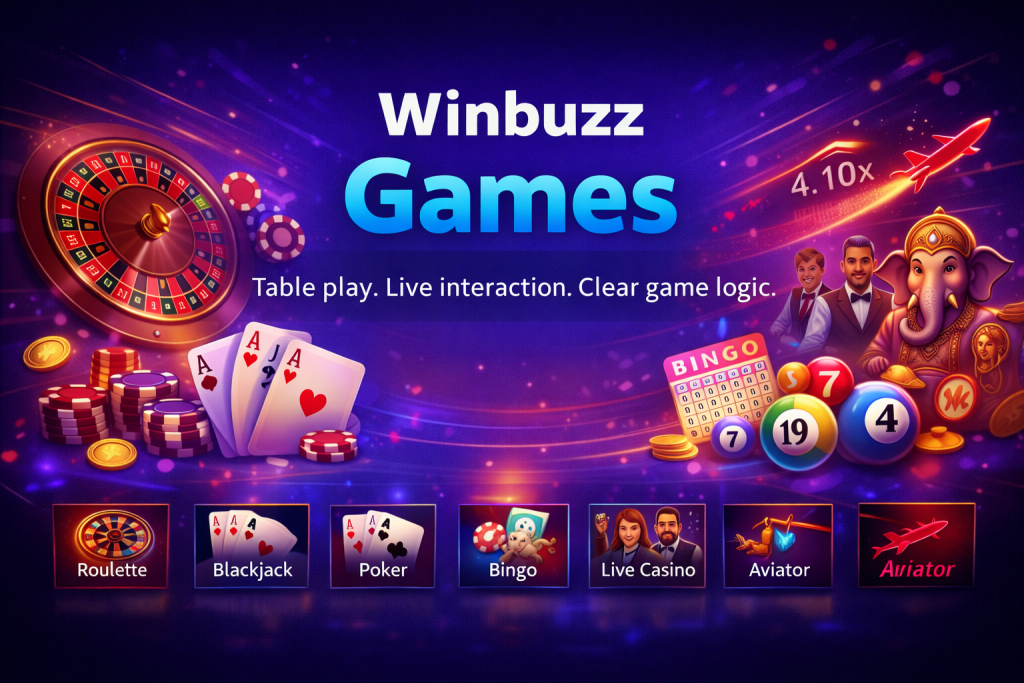
At the core of this section are classic table formats such as Roulette, Blackjack, and Poker. These games are not defined by visual rhythm in the same way as slots. Instead, they are read through rules, pacing, and interaction depth. A roulette spin is still RNG-driven, but it is framed through a betting grid rather than a reel. Blackjack introduces decision points within each round. Poker adds multi-layer interaction, depending on the specific variant. What unites them is that the user is not only observing outcomes but also participating in structured sequences of play. This alone makes the Games section fundamentally different from the Slots section.
Alongside these, Winbuzz includes formats such as Bingo and Live casino, which extend the interaction model even further. Bingo introduces batch-based outcome logic, where multiple results unfold within a single structured round rather than one isolated event at a time. Live casino brings a different dimension entirely — real-time streamed environments where the user interacts with a game hosted by a live dealer. The key distinction here is not whether the game is “better” or “more engaging,” but how the session is framed. Instead of a purely system-driven interface, the user is placed inside a mediated environment that combines platform logic with human presentation.
Finally, Aviator sits in a separate category that requires careful framing. It is neither a slot nor a traditional table game. It is a real-time multiplier model where the session is defined by timing rather than fixed outcomes per round. This does not make it predictive or controllable. The multiplier still resolves independently within its own system logic. However, the perception of control is different because the user decides when to exit rather than simply observing a finished outcome. This makes Aviator structurally unique and requires a more precise explanation than most standard casino categories.
Why Category Clarity Matters More Than Variety
A page like this becomes significantly stronger when it prioritises clarity over volume. Listing many games is easy. Explaining how they differ is where most pages fail. Without clear boundaries, a user may move from slots to roulette to live casino without understanding that they have entered completely different interaction systems. This creates confusion, especially when expectations from one category are incorrectly applied to another. For example, a player accustomed to slot pacing may misread the slower, more deliberate flow of blackjack. A player used to table logic may misunderstand the structure of Aviator if it is presented without context.
The correct approach is to treat each category as a distinct layer within the same platform. Roulette should be framed as a probability grid with independent outcomes. Blackjack should be described as a round-based decision structure. Poker should be positioned as a deeper interaction system that may involve multiple participants or strategic elements depending on the format. Bingo should be explained through grouped outcome logic. Live casino should be clearly separated as a streamed environment. Aviator should be presented as a timing-based multiplier system with its own behavioural pattern. Once these distinctions are in place, the page becomes much easier to navigate.
This approach also reinforces the operator-level tone. Instead of pushing users toward specific games through exaggerated language, the page gives them a framework for understanding what each game type offers and what it does not offer. There are no promises of better outcomes, no implication that one category is more “profitable,” and no attempt to blur the boundaries between fundamentally different systems. The result is a page that feels controlled, structured, and trustworthy — exactly what a multi-game platform should aim for.
How Users Move Between Game Types
The strength of the Winbuzz Games section lies not only in the presence of different formats, but in how users can move between them. A user may begin with a familiar entry point such as roulette or blackjack, where rules are clear and widely recognised. From there, they may explore poker if they are interested in deeper interaction. Others may move toward live casino for a more immersive environment. Some may shift toward bingo for a different pacing model. And some will experiment with Aviator because it offers a distinct kind of session rhythm compared to both slots and table games.
What matters is that this movement is supported by clarity rather than assumption. The platform should not assume that the user understands the differences automatically. It should show them. When the page explains interaction models properly, users can choose their path based on experience preference rather than guesswork. That is a subtle but important difference. It transforms browsing into informed selection.
This is also where the Games page complements the Slots page. Instead of competing with it, it expands the overall system. Slots provide fast, repeatable, visually driven sessions. Games provide structured, rule-based, or real-time interaction. Together, they form a complete environment. Separately, they require different ways of reading. A well-written Games page makes that difference explicit.
Interaction Models Across Table, Live and Real-Time Formats
The Games section becomes genuinely useful when it explains not just what titles are available, but how each category behaves at the interaction level. Unlike slots, where the core loop is consistent — spin, resolve, repeat — the games listed here operate through different structural patterns. Some are round-based with fixed outcomes, some introduce decision points within each round, and others unfold in real time with continuous state changes. These differences are not cosmetic. They define how the user experiences control, pacing, and expectation within each session.
Roulette is the most straightforward entry point into this layer. It is still driven by independent outcomes, but instead of reels, the structure is built around a betting grid. Each round is self-contained. The user places a bet, the wheel resolves, and the result is final. There are no carry-over mechanics and no memory between spins. This makes roulette structurally closer to slots in terms of outcome independence, but very different in how the session is perceived. The grid introduces spatial logic instead of visual rhythm.
Blackjack shifts the model further by introducing decision points. The outcome is not only observed but influenced by choices such as hit, stand, or split. That does not mean the user controls the result, but it changes how the session is read. The player becomes part of the round structure rather than a passive observer. This is a key distinction because it increases cognitive involvement without altering the independence of underlying outcomes.
Poker extends this even further depending on the variant. In some formats, it introduces multi-step interaction, bluffing layers, or player-versus-player dynamics. In others, it remains closer to a structured, rule-based table game. What matters for the page is not the depth of each variant, but the recognition that poker belongs to a different category of engagement. It is not defined by single-round resolution alone, but by sequences and interactions.
Bingo changes pacing entirely. Instead of one outcome per action, it operates through grouped resolution. Multiple numbers are drawn, and the session progresses across a structured pattern rather than isolated events. This creates a different tempo — less about immediate repetition and more about gradual unfolding within a round.
Live casino introduces a hybrid layer. The logic of the games remains the same — roulette is still roulette, blackjack is still blackjack — but the presentation changes. The session becomes real-time, mediated through a live dealer and a streamed interface. The outcome logic does not change, but the perception of the session does. This is a presentation layer, not a mathematical one.
Aviator stands apart from all of these. It is not round-based in the same way, and it is not structured around cards or wheels. It operates as a real-time multiplier that increases until it stops. The user chooses when to exit. This creates a timing-based interaction model. The key point, however, remains the same: the multiplier resolves independently within its system logic. The presence of timing does not create predictability.
Interaction Model Comparison
The table below maps each game type based on how the user interacts with it. It focuses on structure, not outcome quality or value.
Structural Intensity Across Game Types
The graph below compares how “active” each interaction model feels. This is not about profitability or outcomes. It reflects how much the user participates versus observes.
Why This Model Helps the User
When these interaction differences are explained clearly, the Games page stops being a list and becomes a system. A user who prefers passive observation can move toward roulette or bingo. A user who wants more involvement can explore blackjack or poker. A user who is looking for a real-time environment can choose live casino. And a user who is interested in timing-based interaction can experiment with Aviator.
None of these paths is better than another. They are simply different ways of engaging with the same platform. The role of the page is to make those differences visible without exaggeration or simplification.
Reading Each Game Type by Session Logic Rather Than Surface Familiarity
A Games page becomes significantly more useful when it helps the reader interpret each category through its internal structure instead of relying on name recognition alone. This matters because titles such as Roulette, Blackjack, Poker, Bingo, Live casino, and Aviator are all widely familiar, yet familiarity does not automatically translate into correct expectations. Two users may recognise the same game name and still misunderstand what kind of session it creates, how much control it offers, and how quickly rounds move. A strong product-led page closes that gap by describing not only what the games are, but how they behave.
Roulette is best understood as a probability-grid game with independent round resolution. The wheel does not remember previous spins, and the appearance of number patterns in the short term should not be read as system intention. The user experience here is driven by the layout of the betting surface and the clarity of the round cycle. This makes roulette one of the most readable games in the catalogue. It does not demand heavy rule learning, but it still gives the user a stronger sense of structure than a slot because every round is framed through explicit positions and bet types.
Blackjack moves into a more active layer. The user is no longer only choosing a bet position. They are participating within the round through visible decision points. That immediately changes pacing. A blackjack session is less about repeated, identical cycles and more about controlled variation within a familiar ruleset. This makes blackjack suitable for users who want more involvement than roulette but still prefer a recognisable table structure. Importantly, this decision layer should not be framed as guaranteed influence over outcomes. It simply changes how the round is navigated.
Poker deserves even more precise positioning because it is often treated too broadly on casino pages. In practice, poker can refer to multiple formats, each with a different balance between rules, timing, and player interaction. On a page like this, the most useful editorial approach is to frame poker as the deepest interaction category in the Games section. It is structured less like a repeating round and more like a layered sequence. That is why poker often appeals to users looking for more sustained engagement rather than short, isolated decisions.
Bingo should be presented as a grouped-outcome format. Its pace is different from both roulette and blackjack because it unfolds across a shared round structure rather than through one tightly bounded decision cycle. That gives it a different rhythm and a different kind of attention demand. Users often respond well to bingo because its structure is clear even when the active decision density is lower. The session becomes about progression through a collective draw sequence rather than repeated, isolated betting patterns.
Live casino is best described as a presentation shift layered onto familiar game logic. The underlying rules of roulette or blackjack do not change because the game is streamed. What changes is mediation. The round is presented through a live dealer, a real-time interface, and a broadcast-style format that increases immediacy. This makes live casino useful for users who want a more immersive environment, but the page should remain clear that this is a delivery layer, not a change to the fundamental logic of the game.
Aviator requires the most careful explanation of all because it is often misunderstood as either a slot variant or a predictive timing game. In reality, it is better understood as a real-time multiplier format with a user-triggered exit point. That gives it a very different feel from table games and slots alike. The user experiences timing pressure and choice, but that should not be mistaken for system readability in a predictive sense. The multiplier still resolves independently within its own logic. The strongest way to present Aviator is therefore through behaviour and pacing, not through excitement language.
Game Category Map
The table below organises the Winbuzz Games section by session logic, interaction density, and browsing role. It is not a ranking table. It is a structural map for understanding where each category sits in the wider platform.
| Category | Session Logic | User Role | Editorial Reading |
|---|---|---|---|
|
Category Roulette A classic table format built around a betting grid and independent round resolution. |
Session Logic
Grid-based rounds Each round is self-contained. The user selects bet positions and waits for the wheel to resolve without carry-over logic. |
User Role
Structured observer The user actively chooses positions, but the decision density remains lower than in card-led formats. |
Editorial Reading
Clear entry point Useful for users who want readable rules and clean round structure without deeper sequence complexity. |
|
Category Blackjack A round-based card game where the user participates through visible in-round decisions. |
Session Logic
Decision-led rounds The flow stays structured, but user choices such as hit or stand shape how each round unfolds. |
User Role
Active participant The player is more involved than in roulette because the session contains direct interaction inside the round itself. |
Editorial Reading
Higher involvement Suitable for users who want clearer participation without moving into the full sequential depth of poker. |
|
Category Poker The deepest interaction layer in the Games section, depending on the format presented on the platform. |
Session Logic
Sequential structure Poker is read through layered play, format rules, and multi-step interaction rather than one isolated round alone. |
User Role
High agency The user is deeply engaged in the sequence, making poker the most participation-dense category in this set. |
Editorial Reading
Depth-first format Best framed as a sustained interaction category rather than a fast-entry casual game surface. |
|
Category Bingo A grouped-outcome format with a very different pacing model from classic tables or slots. |
Session Logic
Batch progression The round unfolds across a shared draw sequence, creating a broader sense of progression rather than isolated betting cycles. |
User Role
Light participation Active decision density is lower, but the user remains engaged through the grouped round structure. |
Editorial Reading
Alternative tempo Useful for users who prefer a softer, more collective rhythm than the sharper pace of table rounds. |
|
Category Live Casino A real-time delivery layer built on familiar table logic but presented through streamed dealer environments. |
Session Logic
Stream-mediated rounds The underlying game rules stay familiar, while the session gains real-time presence through dealer-led presentation. |
User Role
Immersed participant The player remains inside the normal game framework but experiences it through a more immediate presentation layer. |
Editorial Reading
Presentation upgrade Best understood as a change in delivery and atmosphere, not a change in game mathematics. |
|
Category Aviator A real-time multiplier format with timing-based user response rather than fixed table-round interaction. |
Session Logic
Timing-driven curve The session is shaped by a rising multiplier and a user-triggered exit point, not by cards, wheels, or reels. |
User Role
Reactive participant The user experiences more urgency and direct response, but this should never be confused with predictive control. |
Editorial Reading
Category-specific Aviator needs careful framing because its pacing feels different from both classic tables and standard slot formats. |
Why This Breakdown Makes the Games Page Stronger
The value of a page like this lies in how well it reduces category confusion. Users do not only need to know that roulette, blackjack, poker, bingo, live casino, and Aviator are present on the platform. They need to understand what kind of session each format produces and why that matters. Without that explanation, the catalogue looks broad but undifferentiated. With it, the catalogue becomes legible.
This is especially important because some of these categories may appear equally familiar at first glance while behaving very differently in practice. Roulette and blackjack are both classic table names, but their interaction density is not the same. Live casino may look like a separate category even though its underlying rules can overlap with classic table games. Aviator may feel intuitive because of its direct interface, but it still requires more careful explanation than its presentation suggests. A strong editorial page surfaces those differences clearly instead of assuming that the user will intuit them alone.
That same clarity also protects the operator-level tone. The page remains product-led because it explains structure rather than chasing excitement language. It does not need to overstate the value of live presentation, the depth of poker, or the immediacy of Aviator. The categories already speak for themselves once their logic is explained well. That is exactly the point where a Games page stops sounding promotional and starts sounding credible.
RTP, RNG and Why Game Type Does Not Change Outcome Logic
At the final layer of the Games page, everything should converge into one clear principle: regardless of whether a user chooses Roulette, Blackjack, Poker, Bingo, Live casino, or Aviator, the outcome logic remains strictly separated from the presentation layer and from user behaviour. This is the point where many pages become vague or misleading. A stronger operator-level explanation removes that ambiguity completely.
RTP, where applicable, remains a long-term statistical model. It does not operate at the level of a single session, and it does not adapt to user behaviour, account history, or game switching. This applies across categories, even when the structure of the game changes. A roulette spin, a blackjack hand, or a slot spin all resolve independently within their own systems. Short-term sequences may feel structured or patterned, but that perception does not reflect any memory or correction inside the system.
RNG independence is even more important at this stage because the Games section introduces formats that feel more interactive. Blackjack decisions, poker sequences, or Aviator timing can create the impression that the user is “closer” to the outcome. In reality, these elements change how the session is experienced, not how the result is generated. The system does not respond to previous rounds, does not adjust to player timing, and does not compensate for past outcomes. Each resolution remains independent within its defined rules.
Live casino deserves a separate clarification because it often introduces confusion. The presence of a dealer and a real-time stream changes perception, but it does not change the underlying game logic. Roulette in a live environment is still roulette. Blackjack with a dealer is still blackjack. The stream adds immediacy and atmosphere, but it does not alter probabilities or introduce adaptive behaviour. This is a presentation layer, not a mathematical one.
Aviator is where the separation must be stated most clearly. The format gives the user a moment of choice — when to exit the multiplier. That creates a sense of timing control, but it does not create predictability. The multiplier path resolves independently. The user reacts to it, but does not influence how it is generated. That distinction is essential because Aviator can easily be misunderstood if it is framed only through its interface rather than its logic.
Outcome Independence Across Game Types
The chart below reinforces one idea: different games change interaction, pacing, and perception — but not the independence of outcomes.
Why This Final Layer Matters
The purpose of this final block is not to repeat technical definitions, but to stabilise how the user interprets the entire Games section. Without this clarification, it is easy to misread differences in interaction as differences in outcome logic. A game that feels more active may appear more controllable. A live format may feel more “real” and therefore more predictable. A timing-based interface may suggest that faster reactions lead to better results. None of these assumptions hold once the system is understood correctly.
What actually changes across the Games section is not fairness, probability, or independence. What changes is how the user engages with the system. Roulette is spatial. Blackjack is decision-based. Poker is sequential. Bingo is grouped. Live casino is mediated. Aviator is timing-driven. These are different interaction languages built on top of independent outcome logic.
When the page is structured this way, it does not need exaggeration. It does not need to claim that one game is more rewarding than another or that certain formats provide better chances. The clarity of the system replaces that need. The user is not being pushed toward a choice. They are being given a framework to understand it.
That is exactly what separates a promotional Games page from an operator-level one.